Wednesday, April 17, 2019

Chicken Marbella


Thirty some odd years ago, this dish took the country by a storm, and with good reason. It’s pretty to look at, easy to make, and absolutely delicious. The fruit and olive combination is not as novel as it used to be - but the brown sugar crunch on the chicken can still surprise - it sets the dish apart.

And this is a different take. The original uses two chickens, quartered. The brown sugar is rubbed all over the skin - caked on, actually - and after roasting, the skin is incredible. But my wife avoids eating chicken skin - the fact that it is the best part of a chicken notwithstanding. She always removes it and puts it on my plate. For her last birthday she asked me to make Chicken Marbella. And it occurred to me that without that baked-on burst of brown sugar on the skin, she has been missing, all along, what Chicken Marbella is all about.

So, skinless, boneless Marbella it is. And the sugar can bubble and brown directly on the meat. If she thinks she likes it now (so ran my thoughts) just wait till she gets a load of this -

Boneless chicken cooks faster so the cooking time is reduced - and, happily, that’s a good thing: the prunes are little firmer, their texture more pleasing.

There are other departures; please forgive.  

The big thing is, she really liked it.


About 2-3 lbs. boneless, skinless thighs
1/2 C olive oil
1/2 C red wine vinegar
1/3 C capers, drained, with 1 t juice
1 C pitted prunes
1 C olives
1 C dried tomatoes in oil
1 head of roasted garlic, peeled and minced
2 T dried oregano
2 T dried basil
6 bay leaves
1 t salt
1 t black pepper
up to 1/2 C brown sugar
1/2 C dry white wine
Fresh oregano garnish

As for the olives, I typically get the most interesting mix available at the deli’s olive bar - often with a marinade of its own, which might include onion, more garlic, and hot peppers, you name it. I haven’t regretted it yet. It’s a good place to get the dried tomatoes, too, or for that matter the roasted garlic - but it’s easy to make your own.


1. In a large bowl, mix the oil, vinegar, capers, prunes, olives, dried tomatoes, roasted garlic, oregano, basil, bay leaves, salt, pepper and chicken - everything except the brown sugar and the white wine and garnish. Cover and refrigerate at least a few hours, preferably overnight.


2. Preheat the oven at 350 degrees.

Arrange the chicken pieces in a shallow roasting pan - a half sheet pan is ideal - and distribute the marinated vegetable and prune mixture with its liquid among the pieces. Then, cover each piece of chicken with about 2 t of brown sugar - probably a total of 1/2 C or so brown sugar.


Cook 35 minutes at 350 degrees.

3. Remove from oven, and carefully pour most of the liquid from the pan into a skillet - and over high heat reduce by at least a third - then taste it. If the flavor is thin, reduce it some more, up to by half. But don’t reduce it too much - you’ll be glad for any extra sauce.


4. Transfer chicken and vegetables to a platter, pour the reduced sauce evenly over it.

Or - you could put the sauce in a gravy boat and do it that way.

Serve with a likely starch - cheese grits, rice, pasta, etc.


Friday, February 1, 2019

Sweet Potato Eggplant Gravy


This is one of the greatest gravies of all time, terrific with roasted fowl, pork or veal. The recipe debuted in Paul Prudhomme’s groundbreaking first cookbook, The Louisiana Kitchen, where it was paired with roast duck. Later it was first choice to accompany his famous Tur-duck-en. It is the stuff of legend.

It is terrific with any roast fowl - and I am sure it would pair beautifully with roast pork or veal.

There is another Sweet Potato Eggplant gravy recipe featured on Chef Paul's website, but it is really different. This is the original. If you are actually going to go through the trouble of making Tur-duck-en, to make the experience thoroughly authentic, this gravy is a must. 

Of course, you might prefer (as I would) to consult the internet and order your Tur-duck-en from someone who can competently debone a whole turkey, a whole duck and a whole chicken, leaving each intact, then put them together so as to resemble one big bird -  and in that case, I recommend  The Best Stop Supermarket.

This is the Prudhomme recipe, pretty much, but I see that I have changed it a little over the years. Paul calls for duck fat and duck broth, but in our house (because of a pet duck issue) such a thing is frowned upon by management. So I use olive oil and chicken broth. Other changes are attributable to laziness or personal perversity.

Sweet Potato Eggplant Gravy

Ingredients:

1 medium eggplant
1 medium sweet potato
1 medium onion (finely chopped)
3 cloves garlic, finely chopped
1/4 C olive oil
3 bay leaves
1 1/2 t salt (in all)
1 1/2 t white pepper (in all)
1 1/2 t red pepper (in all)
1 1/2 t thyme leaves
1 t dry mustard
1/2 C brown sugar
7 C chicken broth
3 T Grand Marnier or Triple Sec
1/2 C sliced green onion

Peel and chop eggplant, which should yield around 4 cups. Peel the sweet potato and cut it in two: cut one half into half-inch dice, and set aside; finely chop the other half.

Pour the olive oil into a large skillet and get it hot. Throw in about three fourths (should be about 3 cups) of the eggplant. Saute it till it browns, adding more oil if you need to. Then add the chopped onion and what's left of the eggplant, and cook this until the onion begins to brown.

Next add the finely chopped sweet potato and the garlic. Stirring occasionally, cook for maybe 10 minutes. Add 1 t of the salt, 1 t of the white pepper, 1 t of the red pepper, and all of the thyme, and dry mustard. Cook for a few minutes more.

Now, over the next 10-15 minutes, in small doses, add 6 cups of the broth (which will leave you 1 cup in reserve), and the brown sugar, stirring as you go.

As stated, 10 or 15 minutes should be enough.

Remove from heat, and strain, mashing with a spatula as much liquid - and as much softened vegetable, which will be the body of the sauce - as you can into a large saucepan.

Throw away the vegetables in the strainer.

Over fairly high heat, pour the remaining cup of broth into the saucepan with the strained liquid, and add the diced sweet potato. Cook for about 10 minutes, skimming any froth. Then add the Grand Marnier and the remaining 1/2 t each of salt, red pepper and white pepper (a typical Prudhomme touch: I suppose a second stage of spicing lends a certain boost), bring it to a boil and simmer until it has reduced to about 3 cups.

Stir in the green onions, cook it a minute or so more, and that's it.


Wednesday, November 21, 2018

Artichokes Mandeville


Creamy crabmeat and artichoke salad served in an artichoke pirogue beached upon a light tossed salad, as cool and refreshing as the champagne on ice beside it.


When you feel like getting carried away, a pirogue is the perfect means of transportation.

Here’s what you’ll need:

3 artichokes, of the pointy variety
3 lemons
1/2 lb lump crabmeat
1 stalk of celery, minced
1 scallion, finely sliced, with a lot of green
1/2 C mayonnaise
1/4 C sour cream
1 t minced tarragon

hot sauce
black pepper
peppercorns
bay leaves
olive oil


The Pirogues
Put a stock pot filled with enough water to cover the artichokes over high heat. Stir into the water about a 1/4 cup of good olive oil; a handful of peppercorns; a couple of garlic cloves sliced in half; the juice and carcasses of two lemons; and a bay leaf.

Of the three artichokes, take the two most boat like, and trim them: with a pair of scissors, starting at the bottom, clip the thorny tip of each leaf until you work you way up to the point. Do not touch the leaves that comprise the point of the artichoke. It is the bow of your boat, and should be left intact. These two artichokes will be cooked, then sliced in half - forming four pirogues. But that’s later.

The third artichoke has a different purpose, so don’t worry about trimming it.

When the water is boiling, throw in all three artichokes, cover, and, on low-medium heat, cook 30 minutes. When they are done, remove, drain and allow to cool.

With a sharp knife, remove the stems, and set aside.

Take the untrimmed artichoke, and slice off the point - about 2-3 inches down from the tip. Now remove all the leaves. Since it is cooked, you can do much of this with your fingers. Nestled in the center of things, you will see the choke, prickly and disagreeable. With a paring knife, or a grapefruit spoon, or both, carefully scoop out the choke, leaving something like a basin. Whittle away the rough hide around it, and you will have something resembling a hockey puck with a dip in the top. Something you would put under a table leg to protect the floor.

In the canned goods world, this is what is called an “artichoke bottom.” But it is really the artichoke heart - that is, the heart of the honest-to-God-artichoke. I have to be careful here, because in the canned goods world, what is called an “artichoke heart” is not that at all. It is basically a “baby artichoke,” but do not suppose that to be an infant artichoke. Oh, no, it is a  fully matured artichoke whose growth was stunted because denied the sun by the h-t-G artichoke above it on the stalk. Having no choke, it is wholly edible, and should therefore be forgiven for all the confusion it causes. Whew.

There is a parable in all that, somewhere. One day we will find it in a country song.

Now the two remaining artichokes are ready to become pirogues. With a large, sharp knife carefully slice them in half lengthwise. With a smaller sharp knife, trace a line - giving yourself an outside margin of at least 1/8 inch - around the choke, then cut along that line more and more deeply until you can remove the choke with your fingers. Remove the inner leaves, which are inedible - if you are unsure, take a bite and decide for yourself. But you want enough room for about a half cup of crab salad. More detail about all this, along with some photographs, can be found at Artichoke Pirogues With Crawfish Cardinale 


Now peel the stems, cutting away all but the tender (comparatively, anyway) flesh. Throw them in with the heart and dice it all up, quarter inch. This will assist in turning what would otherwise be  Crabmeat Mandeville into Artichoke Mandeville.

The Crabmeat Salad

In a mixing bowl, blend the celery, green onion, mayonnaise, sour cream, tarragon, a few dashes of your favorite hot sauce, and black pepper to taste. Cut the remaining lemon in half lengthwise. Set one half aside and zest the other. Squeeze the juice of the zested lemon into the crab mixture, and stir in the zest. Fold in the crabmeat, not in any heavy handed way, along with the diced artichoke meat.

Thinly slice the remaining half lemon into so many half moons. Pick the nicest four for garnish.

Now you have four pirogues. Fill them with the crabmeat salad, dividing it evenly. Lend a becoming blush with a sprinkle of cayenne or paprika. Garnish with the lemon slices.

Chill.

Serve atop a green salad, tossed with a light dressing, the simpler perhaps the better, the remaining lemon slices thrown in.

Friday, July 6, 2018

Alabama Hot Slaw


The day I first experienced the St. Florean Memorial Day Barbeque in Florence, Alabama, was the day I discovered Alabama Hot Slaw. It was heaped upon a worthy sandwich of pulled pork, and was just hot enough to get away with the name - though not by much. But it was delicious - and really brought an already terrific sandwich up a couple of notches. Like a perfectly matched wine can take an already perfect dish to a new height. 

Slaw is great on a BBQ sandwich. That is established. It’s been going on in the piedmont of North Carolina for a long time - the red slaw on the coarse-chopped shoulder, and a sandwich that will steal your heart. But as wonderful as that is, this can be even better - because this slaw is better.

1/2 head cabbage, shredded (or a 1 lb bag from your grocer)
2 stalks celery, finely chopped
1 bell pepper, finely chopped
1 onion, finely chopped
1/2 C white vinegar
1/2 C sugar
10 oz. catsup - 10 oz wt is about 1 C
1/2 T tabasco
1/2 t cayenne
1/2 t black pepper
1/2 t salt
1/4 C finely chopped sweet pickle
(Ok, when I have them, I use candied jalapenos instead)

Chill.

Then Chill.

Tuesday, June 5, 2018

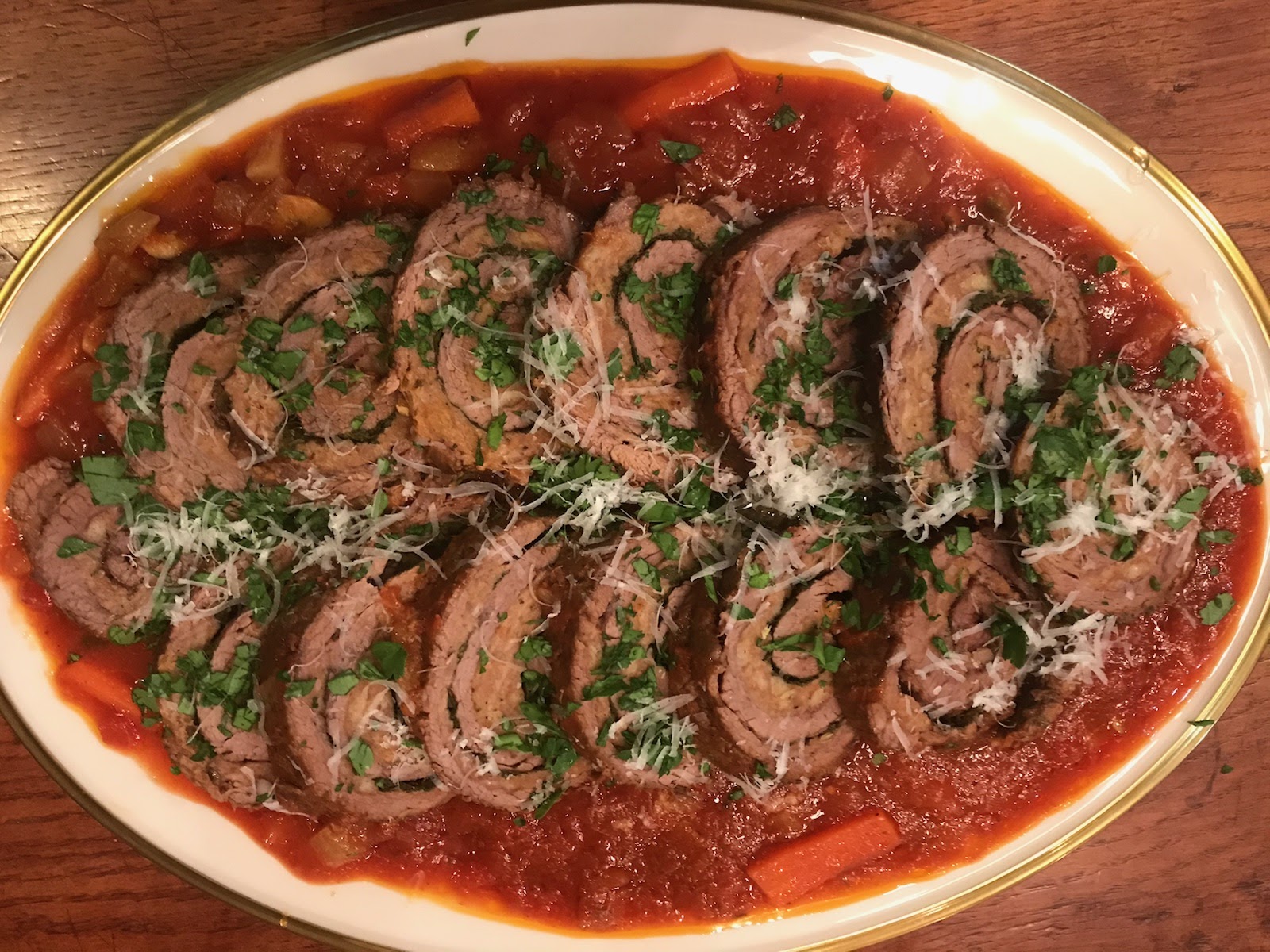
Braciole


In my younger days I lived in Boston - on Hancock Street, just a a few steps off 'Dot' Ave - and played the role of the impoverished student. But it wasn't bad enough to rate the term, really. I had my GI Bill, and a part time job, and rent in a condemned building is awfully cheap. With a little prioritizing, one could live pretty well. Volume could be the key consideration. As my similarly situated friends (there were several habitable apartments in Hancock House, as we called it) quickly learned, on a diet  predominantly of Jell-O and popcorn, we need never stoop to drinking domestic. I hear even now the stately toast - 'Gentlemen, I give you - starvation!' Those were the days.

And when splurging was an option, there was spaghetti. At Purity Supreme, the grocery around the corner, a pound of it went for just 55 cents. The ingredients for a respectable sauce - even with meat - could be had for a few bucks more. There were other delicacies within our means. Like these super thin cuts of round steak - not so cheap by the pound, but sliced so thin that a little went a very long way. They were labled braciole - which I assumed was pronounced like broccoli with an Italian accent - and were terrific done up in a skillet for a breakfast of steak and eggs. 

Then along comes a friend who not only knew how to pronounce braciole (brah-'zhol), but actually had a recipe, and showed us what it was all about. Stuffed with Italian sausage and braised with tomatoes, it was absolutely fantastic with spaghetti. 

I have since learned that braciole is typically made with a stuffing of breadcrumbs, parsley, cheese and pine-nuts - but at best, that's only so-so with spaghetti.  

Down South, odds are you won’t find the already thin sliced braciole cuts on the butcher’s shelf; so you have to butterfly it yourself.

Which brings us to flank steak. It’s not only a great cut of beef - its dimensions are made to order. It's also fairly easy to butterfly.


FOR THE BRAISING SAUCE:


1 medium onion chopped;
5 carrots, julienned;
1 small fennel bulb, thin sliced in 2 inch lengths (save the fronds);
6 garlic cloves, minced;
1 24 oz can tomato puree;
1/2 C chicken broth;
1/2 C dry vermouth;
1/4 C olive oil;
Salt and pepper
  

FOR THE BRACIOLE:


1 flank steak, 1 1/2 pounds or so, butterflied - pounded to about 1/4 inch thickness;
1 pound hot Italian sausage (removed from casing if using actual sausages);
2 C freshly made, and not too fine bread crumbs (if using store-bought, make it 1 1/2 C Panko);
1/2 C parsley, finely chopped;
1/2 C selected fronds from fennel bulb, finely chopped;
Parmesan cheese for sprinkling

TO MAKE IT:


1. PREHEAT OVEN TO 350 DEGREES

2. Butterfly the steak. You’ll need a long, sharp knife. A boning or carving knife is ideal. Lay the steak on the cutting board before you, with the grain (which is easily seen on a flank steak) running up and down. Imagine the steak is a book, and you wish to open it at the middle-most page - but the pages are glued together, so you will have operate. The steak will probably be about an inch thick. You want to cut that thickness in half.  Hold the knife as flatly as possible and cut along the middle of the right edge (or if you are left handed, the left edge) and saw a little, working your way up and down the length of that edge. 


Continue, deepening and smoothing, until you can  peel back the top half of the book, and keep peeling and cutting until it is in fact like an open book - but do not go so far as to cut it in two. Then flatten it with the heel of your hand, cover it with plastic wrap, and pound it with a meat mallet - front and back - as uniformly as possible, until you have a general thickness of about a quarter inch.


Now that you’ve read all this, it may have occurred to you to JUST FIND A VIDEO DEMONSTRATION on line.

If by chance the steak comes apart on you, no worries. It does not have to be all in one piece. You can make more than one braciole. It will all be sliced into so many roundels anyway.


3. Blend sausage with bread crumbs until spreadable, and mold sausage over the steak, covering each piece, maintaining a margin of about an inch; cover it evenly with parsley and fennel fronds; sprinkle with Parmesan cheese.


4. Starting with a wide end - with the grain, as you face it, running left and right, east and west - carefully, tightly roll the steak, just as you would a jelly-roll. The grain should be running with the length of the cylinder you are forming - that way, when the roll is sliced into roundels, you will be cutting against the grain - which makes for better eating.

Then, with 10 inch pieces of string, at 2 1/2 - 3 inch intervals, tie the roll securely. Generously salt and pepper. Cut the roll in half, for better maneuverability. Now you are ready to sear it.


5. In a Dutch oven, over medium high heat, bring the oil to shimmering. Add meat rolls, and, turning with tongs, brown thoroughly. Remove and drain.


6. Reduce heat to medium, add carrots, onions and garlic;  sauté, stirring occasionally. When vegetables have wilted, add broth and wine, scraping the bottom to loosen any tasty residue from the saute. Blend in the tomato puree, and bring to bubbling.

7. Place steak rolls back in Dutch oven, turning them in the sauce. Transfer the Dutch oven to the preheated oven and cook COVERED 1 hour, giving the meat another turn about half way through. Then, turn the rolls again, and cook UNCOVERED 30 minutes.


8. Remove the rolls, allow to cool, and slice into 3/8 - 1/2 inch roundels.


9. Serve atop pasta, covered in sauce and grated cheese. 


Tuesday, May 8, 2018

Creole Fricassee of Chicken a la Jardiniere


This isn't a new twist on an old standby. It's an old twist on an old standby.


Chicken fricassee holds a special place in Creole cuisine - front and center. It is so fundamental, so basic that to an old Creole it must have seemed quite ordinary. But thumbing through archived recipes of a century ago (in The Times Picayune Creole Cookbook), one can see that it did not have to be ordinary. It could be transformed into something stupendous. Fricassee a la Jardiniere is an outright celebration, a showcase of the best of the garden.

You begin with the chicken fricassee - a sauté of chicken, braised in sauce with aromatics, swimming in gravy, laced with green onion - but then you get extravagant. There are already vegetables in the fricassee. That was just part of the foreplay.


Now for the showcase vegetables - they are our second line. And it can be everything a second line should be. Arrange them on top of the fricassee, in and out of the gravy, nestled among drumstick, thigh and breast. Then finish it all in a hot oven.

FIRST LINE FRICASSEE
 
1 C (in all) olive oil
1 1/2 C (in all) flour
1 chicken, cut into 8 pieces
salt and pepper

2 carrots diced
1 1/2 C diced onion
1 C diced fennel bulb
3/4 C diced bell pepper
3/4 C diced celery
3 T finely chopped garlic
1 C green onions, sliced, with a good bit of green - Note: the green onions are not to be added until the braise is finished.

2 C chicken broth
1 can condensed beef broth
3/4 C white wine
2 t paprika
1/2 t cayenne
1/2 t black pepper
1/2 t white pepper
4-5 springs of fresh thyme
Sour cream (optional) 

1. Generously salt and pepper the chicken pieces. Scatter 1 C flour on a plate, and dredge chicken in flour, thoroughly coating each piece.


2. In Dutch oven, over medium high heat, bring 1/2 C oil to shimmering, then brown the chicken, in two batches so as not to over-crowd, 3 or 4 minutes a side, till golden brown all over; set aside.


3. Discard oil, wipe pan - but do not disturb any brown crust left on the bottom - do remove any burnt spots - and add 1/2 C fresh oil.


4. PREHEAT OVEN to 375


5. Blend in 1/2 C flour, stir until smooth, and cook over medium heat, still stirring occasionally, till you have a golden brown roux.


6. Stir in all the vegetables except the green onions, and stir, stir - till vegetables are wilting. Then add paprika, cayenne, black and white pepper - still stirring.


7. Slowly add the chicken broth, stirring until well incorporated. As it thickens, add the consume, a little at a time, and then the wine - still stirring -


8. Place the chicken back in the pot, cover. Lower heat and simmer 45 minutes.

9. Stir in the green onions. You might wish to stir in some sour cream, too.

And the fricassee is basically done. Now to make it a la jardiniere.

SECOND LINE VEGETABLES

10. Add your second line vegetables to the fricassee after it has been braised for 45 minutes. Keep them on the surface - at least don’t fully submerge them. But do make sure everything is at least moistened in the sauce. With tongs lift exposed pieces of chicken enough to allow some crisping of skin.

11. Then place Dutch oven in oven, uncovered, on an upper rack, and cook 15 minutes.

Artichoke. This recipe should feed to bursting four people. So an artichoke, quartered, will provide each an interesting diversion. If you have more than four people, you might wish to cut it into eighths. Or use two artichokes. Bring to a boil enough water to cover the artichoke, add the juice of a lemon, the lemon itself, a bay leaf, a couple of garlic cloves, a teaspoon of peppercorns and some olive oil - don't forget the artichoke. Cook for 30 minutes. Remove,  and drain. Cut off the stem, peel it and slice it. Cut the artichoke in half, length wise. Carefully remove the spiny choke and the tough inner leaves; then - with cut side facing down - carefully slice the halves in two.


Cauliflower. Cut it in half, lengthwise. Half a cauliflower should be plenty (save the other half for a salad). Cut florets from the stalk, and halve the larger ones if it will make the general size more uniform. Over high heat, bring about a quart of water to a boil. In a large bowl, prepare an ice water bath. Drop the florets into the boiling water, give it a few seconds to get back up to a boil, and cook 3 minutes. Remove the florets and drop into the ice water bath. When cool, remove.

Corn. Boil an ear or two for 10 minutes. Remove, and cut into 1/2 inch roundels.

Green peas. 1/C fresh, blanched for three minutes; or thawed frozen - no precooking necessary.

Cherry tomatoes. Especially if you can find a variety of sizes and colors. 1 C should suffice.  


Serve over rice - or dirty rice. Get casual. Use your hands - with the artichoke and the corn, you’ll have to.


There are of course a lot of other options for the second line vegetables: spring onions, roasted in foil; wedges of fennel bulb, roasted without the foil; roasted garlic, patty pan squash, red chilis; blanched asparagus or broccoli florets - and on and on.


Tuesday, February 27, 2018

Cornish Hen Paradis


Madeira demi glace spiked with current jelly and truffles, and adorned with fresh green grapes – an old haute Creole concoction – Sauce Paradis was once upon a time served with the squab at Antoine’s. But it is great on anything – veal scallops browned in butter sure comes to mind – though it especially shines with roasted fowl.

Squab is a young pigeon, right? Getting your hands on a pigeon can be complicated. It can involve more embarrassment than one would expect. When you live in a small town, you can’t count on anonymity. So I gave up on Pigeonneaux Sauce Paradis; I need a bird I can get in the grocery store. A Cornish hen will do. And each guest can still have a picture perfect fine-figure-of-a-fowl on his or her very own plate.
  
My wife says this dish is perfect for Easter, because it has the fresh look of Spring, and there is absolutely nothing ordinary about it. It is, she says, Holiday special. (She really talks like that).

It might be a good idea to serve a light salad as a first course, and then end with the bird - and just the bird. Lots of garlic bread nearby for the sauce.

The last time we made this, we finished by passing the roasting pan around the table for mopping up with the last of the bread.

That’s how everybody knew it was time for dessert.


For each Cornish Hen:

With a pair of Kitchen shears remove the backbone, and save it to make a broth with later on. Spread out the hen, breast up, on a work surface. Press down on the breast until you hear the pop, and flatten the bird. Rub it down with olive oil, and generously salt and pepper.

On a half sheetpan, in a 400 degree oven, roast the birds for 40 to 45 minutes. You want them done enough to come easily off the bone, with some crisp in the skin to stand up to the sauce.


SAUCE PARADIS

1 stick butter
1/4 C flour
2 C condensed beef consomme
1/2 C Madeira
3 T current jelly
1/8 t white pepper
3 C sliced white grapes
black truffle - at least 1 whole truffle, sliced 

In a 2 quart sauce pan, on low heat, melt a stick of butter, then add a quarter cup of flour, and start whisking. You are making a roux. A blondish roux, not a dark one; the darker the roux the less thickening power. Five or ten minutes on low heat should be enough to cook the flour taste out of it, but not so much you’ll wind up with soup instead of sauce.

Then - still whisking - blend in 2 Cups of condensed beef consomme.

Don’t worry, this is not one of those condensed soup recipes from A Man, a Can, and a Plan (which, by the way, is a great little book). The original prescription is for a rich beef broth - so why not condensed beef consomme? Beats looking for a bunch of bones and an extra couple of days’ work. Or reducing four cups of regular beef broth to make it double strength. But a 10.5 ounce can contains only 1 1/4 Cups, so you will need two cans. (The dog is entitled to the remainder mixed in with his dry food).

Back to the sauce – whisking, whisking – Blend in 1/2 Cup Madeira. This makes it old world Southern. Use Rainwater Madeira, and it makes it even more so. There are some good stories about Rainwater Madeira and old Savannah - which I should save for a Savannah recipe.

Add the 1/8 t white pepper and 3 T’s currant jelly. Keep stirring. It will begin to thicken.

Keep cooking and stirring. You don’t want to add the truffles until you are pretty much done with the stirring. No sense in breaking them up any more than you have to.

Once you have the sauce the way you want it, add the truffles and any remaining truffle liquid.


Then add the grapes and turn off the heat. 

Shortly before the birds are ready to take out of the oven, start reheating the sauce.

When the birds are done, sauce them, arranging the grapes and truffle slices for best effect.


Put them back in the oven for five or ten minutes, to glaze the sauce and get them piping hot before serving.


This same recipe works just fine with any manner of roast fowl. Butterfly a chicken, roast it, reheat it with sauce and then cut it up. Think about thinly sliced turkey breast - which is screaming for sauce. What about duck? You like Veal Marsala? You’ll like Veal Madeira. You’ll die for Veal Paradis. Ever notice that any veal dish makes a great pork dish? It goes on and on.

This sauce is special.